

CALL US NOW
314-530-3154
GET A FREE QUOTE
314-530-3154

Anyone who has lived through a St. Louis spring knows the drill. The sky turns green, the sirens go off, and somewhere a basement is filling with water. Between the Mississippi and Meramec rivers, a few derechos a decade, and hail that shows up uninvited every April, this region gets tested by weather more than most. So it’s a fair question if you’re storing anything of value here: what actually happens to your belongings when the storm hits, and your stuff is sitting in a container instead of your house?
The short answer is that it depends heavily on what kind of storage you’re using and where it’s parked. Not all storage units St. Louis Missouri residents rely on are built or positioned the same way, and that difference matters a lot when the water starts rising.
Don’t Let the Next Storm Decide Where Your Belongings End Up.
Talk to The Mobile Attic about smart container placement before severe weather season hits.
A storage unit’s biggest weather vulnerability usually isn’t the unit itself. It’s the ground underneath it. Traditional storage facilities built in low-lying areas near the river bottoms, places like parts of Chesterfield Valley or sections of South County near the Meramec, can take on water just like any building would. If a facility sits below the flood line and the levees don’t hold, the contents inside are at the same risk as a flooded basement, sometimes worse, because nobody’s there to move things to higher ground in time.
This is part of why so many homeowners around here have shifted toward on-site portable containers instead of warehouse-style units. When a container sits on your own driveway or commercial lot, you control the placement. You can pick a spot on a slight grade, away from low points where water pools, instead of depending on a facility’s drainage holding up during a six-inch rain event.
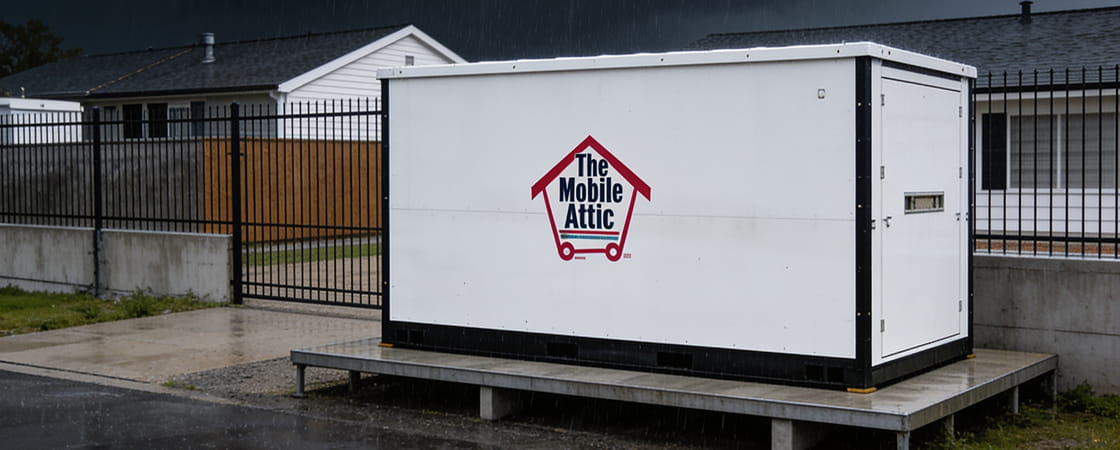
Hail and wind are a different story than flooding, and steel containers handle them well. A quality steel storage container is built to shrug off hail that would dent a car hood or tear through a tarp. The roof is solid, the walls are solid, and there aren’t seams for wind-driven rain to find its way through the way there can be with older wooden sheds or fabric-covered units. During a derecho or a straight-line wind event, which St. Louis sees more often than people from other regions might expect, a properly placed steel container isn’t going anywhere and isn’t letting much in.
Water intrusion in storms usually comes down to two things: standing water at ground level, and condensation from temperature swings. The first is a placement issue, solved by setting the container on a level spot with some elevation and decent drainage around it. The second is a humidity issue that affects any enclosed space, container or building, and it’s why packing materials and how items are arranged inside the unit make a real difference over time.
Flood-Smart Storage Starts With the Right Spot.
The Mobile Attic helps you find placement that keeps water out, season after season.
Let’s be honest about the scenario people actually worry about: a flash flood or a river overflow during a multi-day rain event. If a container is sitting in a yard that floods, water can get in underneath the doors or through ground-level vents if the container isn’t elevated. This is true of any storage option, indoor or outdoor, that ends up below the waterline. The difference with a well-placed portable container is that it’s much easier to keep out of harm’s way in the first place. You’re not stuck with whatever spot a facility happens to occupy near the river; you pick where the box sits.
For residents in flood-prone pockets of the metro, like areas near Creve Coeur Lake, the Earth City industrial corridor, or low sections along the River Des Peres, this is worth thinking through before a unit ever gets delivered. A few inches of elevation and a spot away from natural drainage paths can be the difference between a routine spring storm and a ruined collection of furniture, electronics, or business inventory.
When people compare facility-based storage to mobile containers, weather resilience often gets overlooked in favor of price and convenience. But anyone who’s filed an insurance claim over storm damage knows it should be near the top of the list. A few things worth checking before committing to any storage option in this region:
This is also where mini storage St. Louis options can fall short for people with larger households or business inventories. A smaller unit crammed full of belongings doesn’t leave room for the kind of organization that keeps items off the floor, which matters if any water does find its way in.
Bigger Storms Call for Smarter Storage Decisions.
Get a free consultation on container placement from The Mobile Attic’s team.
St. Louis weather isn’t getting any calmer, and pretending otherwise doesn’t help anyone planning a move, a renovation, or just clearing out a garage. The good news is that most storm-related storage disasters trace back to a handful of preventable factors: poor placement, low-quality units, or facilities sitting in spots that flood every few years like clockwork. None of that is unavoidable.
Yes, if it’s placed in a low spot or an area prone to standing water. Containers themselves are weather-sealed, but they aren’t boats. Placement on elevated, well-draining ground is what actually keeps water out.
Quality steel containers hold up well against hail that would dent vehicles or damage shingles. The solid construction that makes them secure also makes them resistant to the kind of denting and puncturing that lighter materials suffer.
Many St. Louis residents prefer this because it puts placement decisions in their hands rather than relying on a facility’s location. You can choose higher ground and keep an eye on the unit during severe weather.
Cardboard boxes, paper documents, fabric furniture, and electronics sitting directly on the floor are the most vulnerable. Using plastic totes and pallets to keep items elevated off the container floor adds a real layer of protection.
Not necessarily. St. Louis basements flood constantly during heavy rain events, often faster and with less warning than a well-placed outdoor container would experience. Elevation and drainage matter more than whether something is indoors or outdoors.
County and city flood maps are public and searchable by address. It’s worth checking before deciding where to place any long-term storage on a property.
Portable containers can typically be relocated with advance notice if severe weather is forecast, which is one advantage over fixed storage units that can’t be moved at all.
Coverage varies by policy and provider, so it’s worth checking with both a homeowner’s or renter’s policy and the storage provider directly to understand what’s covered before storm season arrives.
Choosing the right storage setup before severe weather hits is a lot easier than dealing with damage after the fact. The Mobile Attic works with St. Louis homeowners and businesses to find container placement that actually accounts for local flood risk, not just convenience. A quick conversation now can save a lot of headaches the next time the sky turns green. Contact The Mobile Attic now by phone or get a free quote online to get started!


Happy Customers

years of LOCAL moving experience
Greater St. Louis counties, and beyond